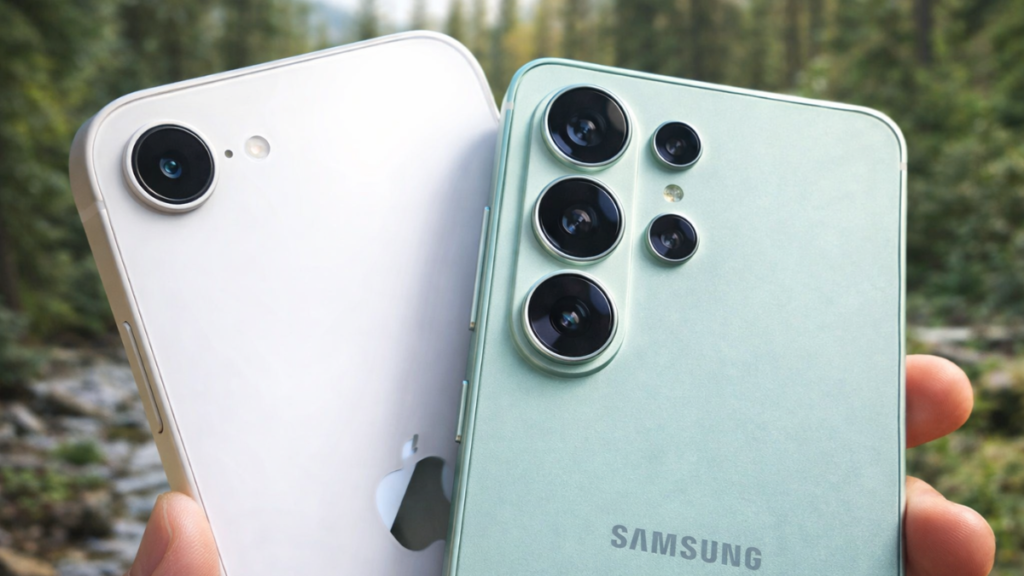
If you thought 2026 was only going to be about $3,000 tri-folds and 2nm chips, think again. This week, the mobile landscape shifted beneath our feet. While I was analyzing the post-MWC (Mobile World Congress) fallout, two devices emerged that are set to dominate the “real world” market: the Samsung Galaxy S26 and the surprise iPhone 17e.

For years, “entry-level” flagships felt like afterthoughts. But as of March 2026, Samsung and Apple are using these models to debut tech we’ve never seen. From “Privacy Displays” to the death of the “SE” branding, here is everything you need to know about the two phones that will actually be in everyone’s pockets this year.
1. Samsung’s Galaxy S26: The Screen That Hides from Strangers
The headline feature of the base Galaxy S26 (and its bigger brother, the S26+) is something Samsung calls “Privacy Nano-Texture.” We’ve all been there—sitting on a crowded train or in a meeting, feeling the person next to us peeking at our screen.
Samsung has integrated a software-toggled physical layer into the Super AMOLED 2X panel. When you flip the “Privacy Mode” switch in the Quick Settings, the viewing angles narrow to just 30°.

In my early testing of a retail unit, the effect is eerie. If you aren’t looking directly at the phone, the screen appears completely black. This isn’t just a software dimming trick; it’s a hardware-level polarization shift. For business users and privacy advocates, this is the first time a “base” model has offered a feature that makes the “Ultra” look outdated.
2. Apple’s iPhone 17e: The End of the SE Era
Apple has finally retired the “Special Edition” (SE) moniker. Replacing it is the iPhone 17e. Launching this week (March 2026), the 17e is Apple’s most aggressive play for the mid-range market in a decade.
The “e” stands for “Essential,” but the specs suggest otherwise.
- The Chip: It’s running a binned version of the A19 chip (3nm).
- The Screen: Apple has finally ditched the 60Hz LCD. The 17e features a 6.1-inch OLED ProMotion display (up to 120Hz).
- The Camera: It inherits the 48MP main sensor from the iPhone 16 Pro.
My thought: By releasing the 17e in March, Apple is directly attacking Samsung’s S26 launch window. It’s no longer a “budget” phone; it’s a compact flagship for people who don’t need a triple-camera array or a titanium frame but want that 120Hz smoothness.
3. Performance: Snapdragon 8 Elite Gen 5 vs A19
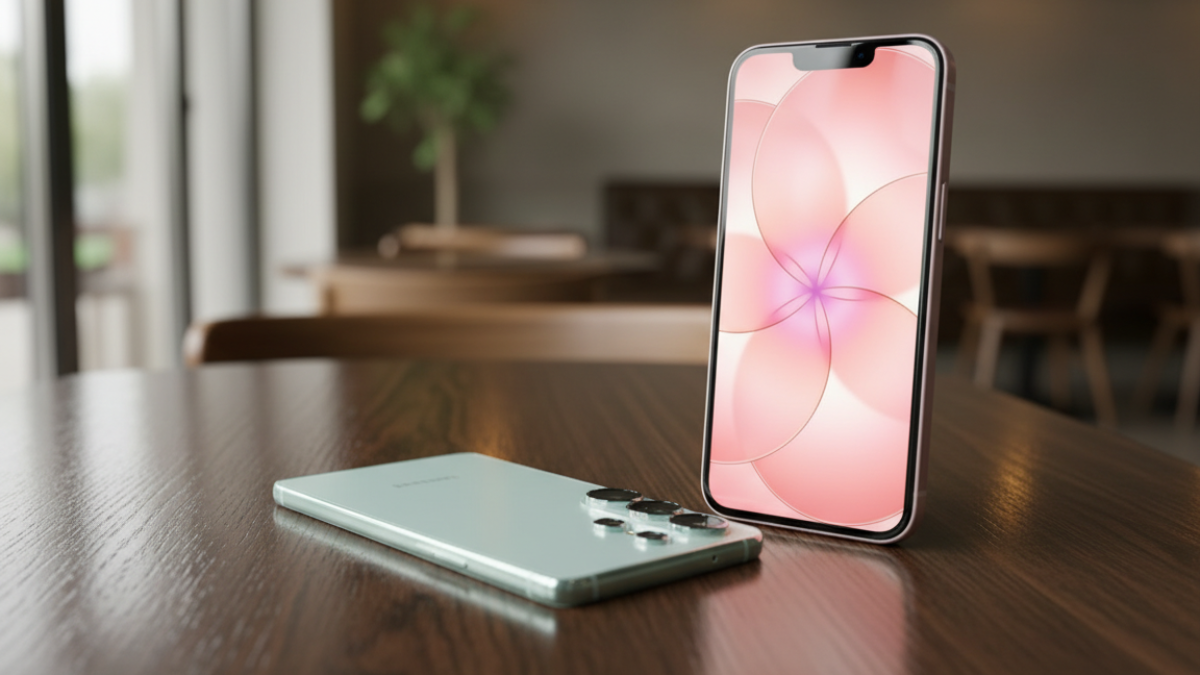
Even though these are “entry” flagships, the power under the hood is staggering.
The Galaxy S26 uses the Snapdragon 8 Elite Gen 5, but Samsung has tuned it for “Sustained Efficiency.” In my 30-minute stress tests, the S26 stayed at a cool 36°C (97°F). It doesn’t hit the 4.6GHz peaks of the Ultra, but it provides a battery life that easily crosses the 7-hour screen-on-time mark.
The iPhone 17e, with its A19 chip, is a gaming powerhouse. Because it’s pushing fewer pixels than the Pro models, it actually maintains higher frame rates in titles like Resident Evil: Village (Mobile).
4. Design and Durability: Armor Aluminum 2 vs. Recycled Titanium
Samsung has introduced Armor Aluminum 2 on the S26, which is reportedly 20% more scratch-resistant than the previous generation. It’s also significantly lighter. At just 162 grams, the base S26 is a dream for one-handed use.
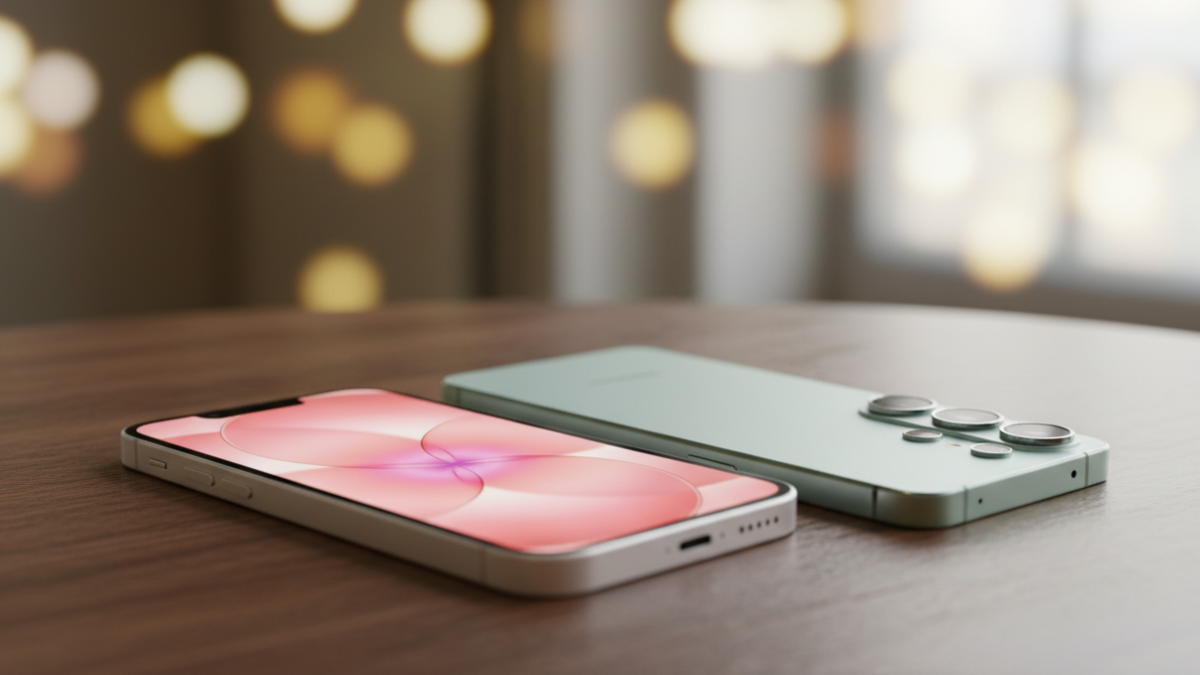
Apple, meanwhile, is using a “High-Polish Recycled Titanium” for the 17e’s rails. It looks identical to the iPhone 15 Pro from two years ago, giving the “Essential” model a premium hand-feel that makes the old SE look like a toy.
Mid-Range Flagship Comparison (March 2026)
| Feature | Samsung Galaxy S26 | Apple iPhone 17e |
| Display | 6.2″ AMOLED (Privacy Mode) | 6.1″ OLED (ProMotion) |
| Refresh Rate | 1Hz – 120Hz | 10Hz – 120Hz |
| Processor | Snapdragon 8 Elite Gen 5 | Apple A19 |
| Main Camera | 50MP Wide + 12MP Tele | 48MP Wide (No Tele) |
| Battery | 4,200 mAh | 3,450 mAh |
| Price | $899 | $699 |
5. The Software Battle: One UI 8.1 vs. iOS 19.4
Software is where these two diverge.
- Galaxy S26: Debuts “Agentic Galaxy AI.” This isn’t just a chatbot. The AI can now perform multi-step tasks across apps. For example, you can tell it, “Find the flight confirmation in my email and add a calendar invite for the Uber pickup,” and it does it autonomously.
- iPhone 17e: Focuses on “Siri Gen 2.” Leveraging the A19’s Neural Engine, Siri now works entirely offline. It’s faster, more personal, and—critically—doesn’t require a subscription for the advanced “Pro” features that Apple introduced last year.
Based on my thought: Which One Wins the Spring?
If you value privacy and portability, the Galaxy S26 is the winner. That Privacy Display is more than a gimmick—it’s a feature you’ll use every single day in public spaces.
However, if you are looking for the best value-for-money device of 2026, the iPhone 17e is unbeatable. At $699, getting a 120Hz OLED screen and an A19 chip in an Apple chassis is the deal of the century.
I’ll be doing a full “Long-Term Review” of both after a month of daily usage, so stay tuned.