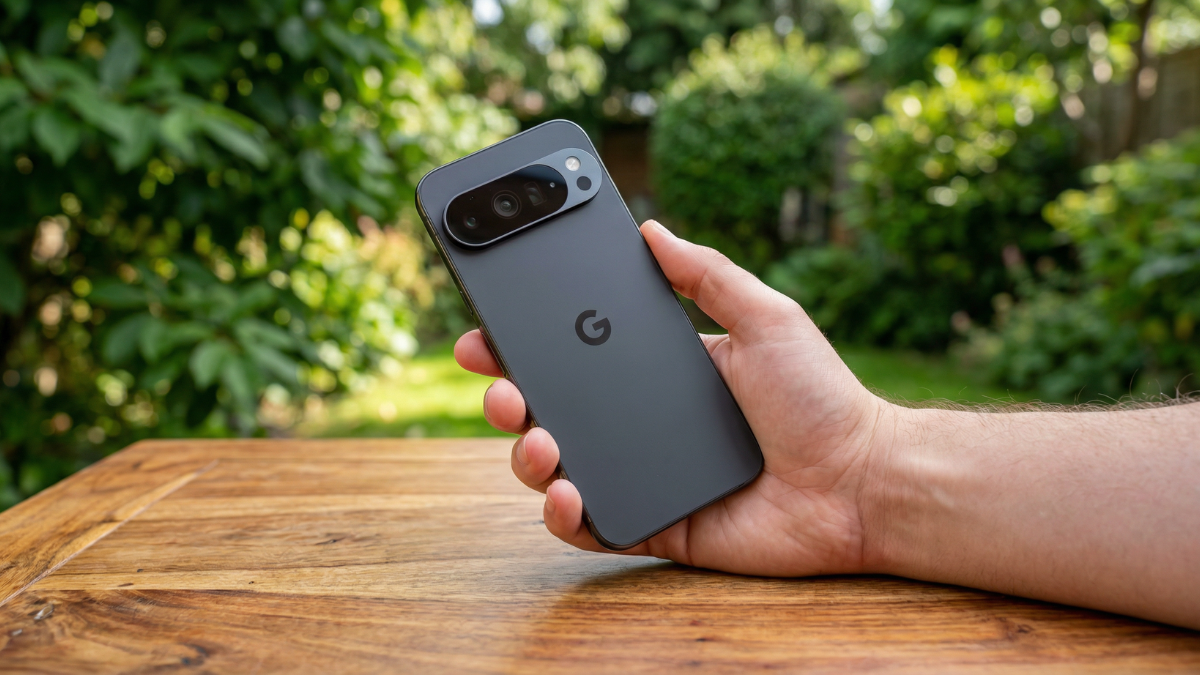
Google says the Tensor G5 has a 34% faster CPU and a 60% more powerful TPU. But in benchmarks, it is not a benchmark killer and will always lag behind Qualcomm and Apple designs. After seven months of real world use, here is where the Pixel 10 actually stands in March 2026.

The AnTuTu Numbers: Less Than Half of Snapdragon
Beebom ran the AnTuTu benchmark on the Pixel 10 Pro, and the Tensor G5 managed to achieve an overall score of 1,291,252 points. The 8 core Arm Cortex CPU received 457,073 points and the new DXT 48 1536 GPU scored 382,578 points.
Looking at the AnTuTu score, it is clear that the Tensor G5 is not a flagship chipset. Compared to flagship chipsets like the Snapdragon 8 Elite and Apple A18 Pro, the Tensor G5 performance looks mediocre at best. Other chipsets have crossed the 2 million mark, but the Tensor G5 is struggling to touch even 1.5 million points.
For context, the current AnTuTu number one, the iQOO 15 Ultra, scores 4,208,894. The Pixel 10 Pro scores less than a third of that number.
Geekbench: Better, But Still Behind
In the Geekbench 6 CPU test, the Tensor G5 scored 2,285 in single core and 6,191 in multi core. While not flagship level CPU performance, the Tensor G5 delivers 35% faster multi core performance than the Tensor G4.
However, the Pixel 10 sits some way behind the iPhone 16’s impressive custom single core showing and the multi processing powerhouse Snapdragon 8 Elite phones in its price bracket.
The GPU Problem: Worse Than the Pixel 9 Pro
This is where the story gets uncomfortable.
The Pixel 10 Pro achieved a score of 3,707 in a Vulkan benchmark. This not only puts it way below top smartphones like the Samsung Galaxy S25 Plus (26,333), but also below its predecessor, the Pixel 9 Pro, which achieved 9,023 points.
Graphics performance is underwhelming for a phone that is priced like a flagship. Overall, the Tensor G5 feels like a step forward in CPU performance and efficiency, but a step back in GPU power.
GSMArena notes that demanding titles like Genshin Impact cannot keep a steady 60fps at its highest settings.
The Tensor G5 Chip: What Is Actually Inside
The Tensor G5 sports a single Cortex X4 core clocked at a colossal 3.78GHz, five Cortex A725s at 3.05GHz, and two power efficient Cortex A520s at 2.25GHz.
The custom Google Tensor G5 that powers the entire Pixel 10 lineup is a noticeable upgrade over the Tensor G4. Instead of using Samsung Exynos fabrication, Google switched to TSMC as their manufacturer and used their state of the art N3E 3nm processing node.
| Spec | Pixel 10 Pro | Pixel 10 Pro XL |
|---|---|---|
| Display | 6.3-inch LTPO OLED, 120Hz, 3,300 nits peak | 6.8-inch LTPO OLED, 120Hz, 3,300 nits peak |
| Chipset | Tensor G5 (3nm TSMC) | Tensor G5 (3nm TSMC) |
| RAM | 16GB | 16GB |
| Storage | 128GB / 256GB / 512GB / 1TB | 128GB / 256GB / 512GB / 1TB |
| Rear Camera | 50MP wide + 48MP ultrawide + 48MP 5x telephoto | Same |
| Front Camera | 42MP ultrawide | Same |
| Battery | 4,870mAh | 5,200mAh |
| Charging | 45W wired, 25W wireless Qi2 | 45W wired, 25W wireless Qi2 |
| Price | $999 | $1,199 |
| Announced | August 20, 2025 | August 20, 2025 |
| Released | August 28, 2025 | August 28, 2025 |
The One Thing Google Got Right: Thermals
Google’s new Pixel 10 series ushers in Tensor G5 which, while still unimpressive on benchmarks, seems to largely solve overheating problems. The chip simply does not heat up in normal day to day use as Tensor G4 did. In fact, it runs cooler than both the Galaxy Z Fold 7 and Nothing Phone 3.
Compared to Exynos, it provides better efficiency, performance improvements, and runs at lower temperatures. Tensor overheating often plagued older Pixel models, and was revealed to be the number one reason older handsets were returned.
So the Tensor G5 finally fixed the overheating issue. That is a genuine, meaningful improvement.
Does Any of This Actually Matter?
There will be traditional gains every year, like Tensor G5’s CPU being 34% faster, an improvement that is not really noticeable in day to day usage, but what Google really cares about is making possible more on device generative AI.
It is really the software where the Pixel 10 Pro’s main appeal lies. All the smoothness and attention to certain details that other makers overlook, plus AI based features that you cannot quite get elsewhere.
But some classic Google pain points have not been addressed: charging remains unacceptably slow, battery life is not competitive, the chipset is behind the curve and throttles like few others.
The Pixel 10 is a phone you buy for software, AI features, and camera processing. It is not a phone you buy for raw performance. And at $999 for the Pro, that trade off is one every buyer needs to understand before purchasing.

Written by Ameer Hamza
Tech Analyst and Founder of Global Tech Press. Currently expanding the GTP hardware testing labs and building the next generation of digital tech media.